How Long Does it Take to Learn to Surf? Realistic Timeline
Ready to Catch Your First Wave?
Join our beginner-friendly surf lessons and experience the thrill of surfing with patient, experienced instructors.
The Honest Answer Nobody Wants to Hear
How long does it take to learn to surf? It depends.
That unsatisfying answer frustrates people, but it's the truth. Variables including fitness, ocean experience, lesson frequency, wave conditions, instruction quality, and natural aptitude all influence progression rates.
What we can offer – based on teaching thousands of beginners at Lombok's beaches – is a realistic timeline showing what's actually achievable at each stage. No marketing promises, just honest observations from years of watching people transform from nervous landlubbers to competent wave-riders.
Stage 1: Standing Up (1-3 Hours)
What Happens
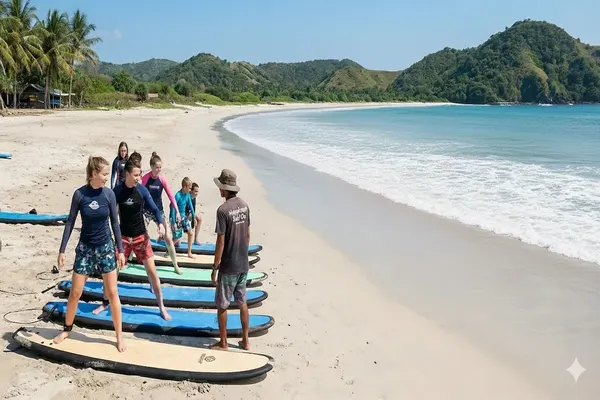
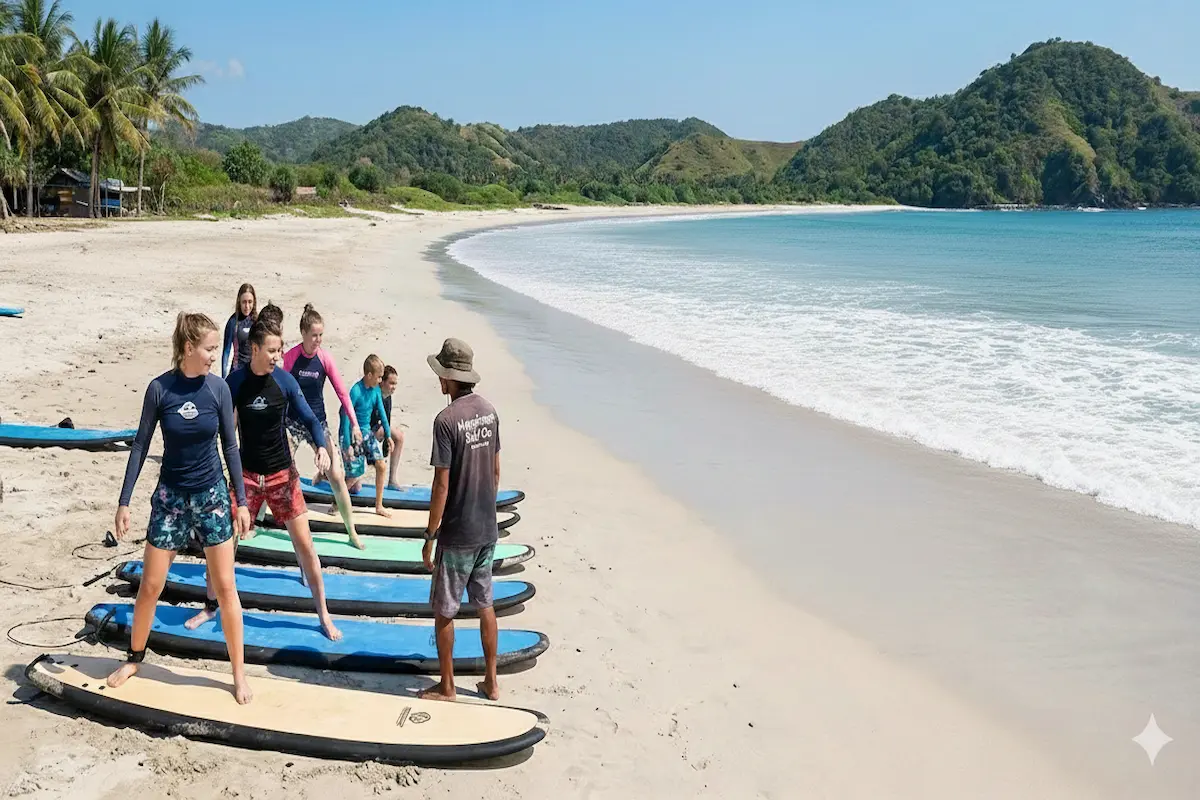
Your first surf lesson begins on sand. The pop-up gets drilled until muscle memory starts forming. Then you enter the water, typically at Selong Belanak or similarly gentle spots.
Instructors push you into whitewater (already-broken waves). You attempt the pop-up on a moving, unstable surface for the first time. You fall. You try again. You fall differently. Eventually, for a few glorious seconds, you stand.
Success Rate
Approximately 85-90% of beginner students stand up on their surfboard during their first lesson. The percentage increases with foam boards, patient instructors, and appropriate wave selection.
What "Standing Up" Actually Means
Let's be clear: standing up in your first lesson doesn't mean surfing. It means achieving vertical position on a board being pushed by white water. Your stance is wrong, your balance is precarious, and you're moving straight toward shore.
But it's a start. And it feels absolutely incredible.
Factors That Speed This Up
- Previous board sports experience (snowboarding, skateboarding, wakeboarding)
- Core strength and body awareness
- Swimming comfort in ocean conditions
- Quality instruction with proper progression
- Appropriate equipment (larger, more stable boards)
Factors That Slow This Down
- Fear of water or waves
- Poor upper body strength for paddling
- Rushing the pop-up technique
- Crowded conditions causing anxiety
- Boards too small for skill level
Stage 2: Consistent Whitewater Riding (3-5 Days)
What Happens
With several sessions under your belt, patterns solidify. The pop-up becomes more reliable. You catch more waves than you miss. Sessions start feeling fun rather than purely frustrating.
At this stage, you're still riding whitewater – the foamy soup after waves break. But you're riding it with increasing confidence.
Key Developments
- Pop-up timing improves: You start standing before the wave's energy dissipates
- Stance adjusts naturally: Feet find better positions without thinking
- Paddle strength builds: Arms hurt less, catch rate increases
- Wave reading begins: You start choosing which whitewater sections to ride
Realistic Expectations
By day three or four, most students can:
- Catch 50-70% of waves they attempt
- Stand up most of the time
- Ride whitewater for several seconds
- Fall more gracefully
This is where multi-day lesson packages prove valuable. Consistency compounds – daily practice builds faster than weekly sessions.
Stage 3: Catching Unbroken Waves (1-2 Weeks)
The Big Transition
This stage marks the shift from "taking lessons" to "surfing." Green waves – unbroken swells that haven't yet turned to whitewater – behave differently. They're faster, more powerful, and require actual wave reading.
Your instructor moves you to slightly deeper water. Instead of waiting for waves to break and push you, you paddle toward approaching swells and attempt to catch them before they break.
What Changes
Everything, basically:
- Positioning: You need to be in the right place when the wave arrives
- Timing: Too early and you paddle over the top; too late and it breaks on your head
- Paddle power: Green waves require harder, more explosive paddling
- Pop-up speed: You must stand faster as the wave steepens
- Wave selection: Not every wave works; learning to read sets matters
Why This Takes Time
Catching green waves requires several skills working simultaneously. Unlike whitewater – where instructors can push you and the wave does most of the work – green waves demand you to do everything yourself, coordinated correctly, in about three seconds.
Private coaching often accelerates this transition because instructors can provide real-time feedback on positioning and timing.
Progress Markers
You're progressing when you:
- Paddle into waves without instructor push
- Recognize which waves will work for you
- Feel the wave "pick up" your board
- Stand with forward momentum, not just being pushed
Stage 4: Angling Across the Wave Face (3-4 Weeks)
Beyond Going Straight
Beginning surfers ride straight toward shore – following the wave's energy in the most direct path. The next level involves angling along the wave face, riding parallel(ish) to the beach rather than perpendicular.
This changes everything. Angled rides are longer, faster, and more controlled. This is where surfing starts to feel like what you watched in videos.
Technical Requirements
- Looking where you want to go: Your body follows your gaze
- Weight distribution: Shifting pressure to create direction
- Speed generation: Basic pumping motions
- Wave awareness: Reading how the wave will break to choose direction
Why It Matters
Riding across the wave face opens:
- Longer rides (following the wave's energy rather than escaping it)
- Better wave selection (knowing which direction breaks offer more ride)
- Foundation for actual maneuvers
- Dramatically more satisfying sessions
Stage 5: Consistent Intermediate Skills (2-3 Months)
What "Intermediate" Actually Means
Intermediate surfers can:
- Paddle out through breaking waves
- Catch green waves independently
- Ride along the wave face consistently
- Generate basic speed
- Navigate lineups safely
- Make basic top and bottom turns
Getting Here
Two to three months of regular surfing (let's say 3-4 sessions per week) typically develops these skills for naturally athletic learners. Less frequent practice extends this timeline proportionally.
Surf camps compress this process through immersion – daily sessions, consistent feedback, and surf-focused lifestyle.
What Remains Challenging
Even at the intermediate level, certain situations humble you:
- Larger waves
- Crowded lineups
- Fast, hollow sections
- Strong currents
- Unfamiliar breaks
That's okay. Surf guides exist partly to help intermediate surfers navigate these challenges.
Stage 6: Advanced Skills (1-3+ Years)
The Long Road
Advanced surfing – tube riding, aerial maneuvers, critical sections, powerful waves – requires years of dedicated practice. There are no shortcuts.
What Separates Levels
- Wave count: Advanced surfers have caught tens of thousands of waves
- Condition exposure: They've surfed every imaginable scenario
- Pattern recognition: They read waves unconsciously
- Physical development: Surf-specific strength, flexibility, and endurance
- Mental game: Comfort in challenging situations
Should This Discourage You?
Absolutely not. The intermediate plateau is where most recreational surfers live happily for decades. You don't need aerials to enjoy surfing. The feeling of gliding along a wave face satisfies at every skill level.
Accelerating Your Timeline
What Actually Helps
Consistent practice: Daily sessions beat weekly heroic efforts. Muscle memory requires repetition. Extended stays in Lombok provide immersion opportunities.
Quality instruction: Good coaches identify issues invisible to beginners. Invest in lessons rather than struggling alone.
Appropriate equipment: Bigger boards for longer. Ego-surfing on shortboards delays progression. See our rental guide for sizing advice.
Video review: Watching yourself reveals issues that feel invisible. Many surf schools offer video analysis.
Physical preparation: Surf fitness before arriving means more productive wave time.
Mental preparation: Expect plateaus. Celebrate small wins. Compare only to your previous self.
What Doesn't Help
- Surfing once monthly and expecting rapid improvement
- Using boards too small for your level
- Rushing stages (particularly the green wave transition)
- Surfing beyond your ability in dangerous conditions
- Comparing your day three to someone's year three
Lombok-Specific Timeline Advantages
Why People Learn Faster Here
Lombok offers conditions that accelerate learning:
Warm water: No wetsuit restrictions. Longer sessions. More comfortable practice.
Consistent waves: Reliable surf reduces frustrating flat days.
Uncrowded lineups: More waves per session. Less anxiety.
Quality instruction: Experienced local instructors who understand progression.
Graduated breaks: Gentle learner spots with accessible step-up waves nearby.
Dedicated focus: Vacation mode means surf is your priority, not a squeezed-in hobby.
A week of focused learning in Lombok often produces more progress than months of occasional home-beach sessions.
Realistic Expectations Summary
| Stage | Timeline | Skills | |-------|----------|--------| | Stand up | 1-3 hours | Pop-up on whitewater | | Consistent whitewater | 3-5 days | Reliable balance, catching waves | | Green waves | 1-2 weeks | Paddle into unbroken waves | | Angling | 3-4 weeks | Ride along wave face | | Intermediate | 2-3 months | Independent surfing, basic turns | | Advanced | 1-3+ years | High-performance maneuvers |
These are averages for athletic learners with consistent practice. Your timeline may differ. That's fine. Surfing isn't a race.
The Truth About Learning Curves
Everyone plateaus. Everyone has frustrating sessions where skills seem to regress. Everyone watches less experienced surfers have better days.
The people who become good surfers aren't necessarily the most talented – they're the ones who persist through plateaus, maintain consistent practice, and find joy in the process rather than obsessing over outcomes.
Start your surf journey in Lombok's warm, forgiving waters. The timeline takes care of itself when you're having fun.
Frequently Asked Questions
Ready to Catch Your First Wave?
Join our beginner-friendly surf lessons and experience the thrill of surfing with patient, experienced instructors.
Book a Surf Lesson